



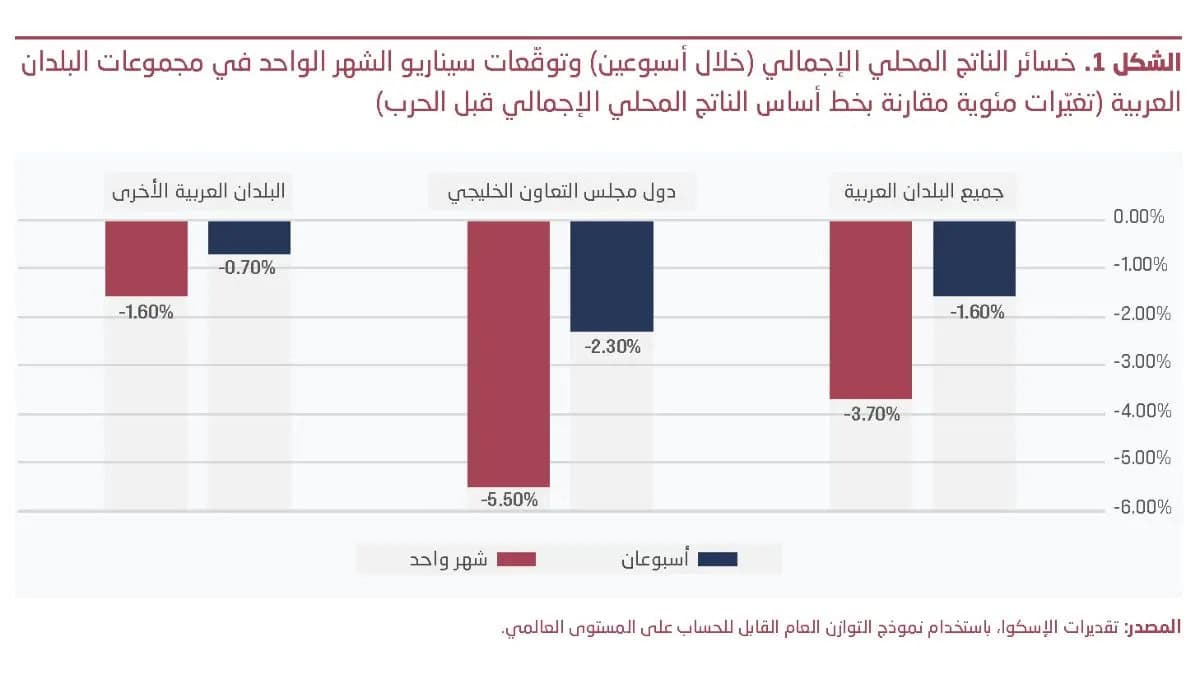
The United Nations Economic and Social Commission for Western Asia (ESCWA) published a study titled “Conflict and Its Repercussions: The Escalating Crisis in the Arab Region,” warning that “if the conflict continues for a month, losses could reach around $150 billion, equivalent to 3.7% of the regional GDP. The conflict has already imposed a heavy economic toll across the entire Arab region, with preliminary estimates indicating regional losses of about $63 billion in the first two weeks.”
The study indicated that “the shock’s impact spreads through energy markets, trade routes, air travel networks, and financial systems. Shipping through the Strait of Hormuz dropped by about 97%, resulting in estimated cargo shipping losses of around $2.4 billion per day, and cumulative trade losses of approximately $30 billion over two weeks. Between February 28 and March 12, around 19,000 flights were canceled across nine major regional airports, leading to airline revenue losses of roughly $1.9 billion.”

The Acting Executive Secretary of ESCWA, Mourad Wahba, said: “This study shows that the economic impacts of the conflict are crystallizing rapidly and simultaneously across various levels.” He added: “What began as a security escalation has now extended into the regional economy through trade, energy, transport, and finance—with ensuing consequences that exert direct pressure on growth, financial stability, and the humanitarian situation.”

The study further notes that “the region entered the crisis with limited capacity to withstand long-term shocks. Before the latest escalation, there were about 210 million people — roughly 43% of the region’s population — living in conflict-affected areas, including 82 million people in need of humanitarian assistance. In 2025, the Gulf Cooperation Council countries provided approximately $4.4 billion in humanitarian aid, accounting for around 43% of the total assistance directed to conflict-affected countries in the region.”
The greatest impact is likely to fall on energy-importing economies. When the price of oil reaches $100 per barrel, the additional annual import bill for Tunisia, Lebanon, and Egypt is expected to rise by about $6.8 billion compared to what their 2026 budgets had anticipated, in addition to the fiscal strain already faced by countries that have been grappling with financial constraints since before the conflict.
According to the study, “Lebanon is facing one of the most serious direct consequences. The escalation that erupted on March 2 marked a new and more intense level of Israeli violence. If the air raids continue to escalate, economic losses could rise dramatically, as the attacks are damaging infrastructure, trade, and essential services. This affects an economy that had already contracted by nearly 40% since 2019. The latest escalation has severely strained the humanitarian situation, with the death toll reaching 634 as of March 11 and the number of displaced people nearing one million.”
Wahba added: “Our concern is not limited to the scale of the direct losses but extends to how these losses interact with the region’s pre-existing structural vulnerabilities. For countries with limited fiscal space, heavy reliance on imports, or severe humanitarian pressures, a prolonged conflict may exceed their capacity to absorb further shocks, with all that entails for economic stability, social cohesion, and the humanitarian situation.”
The study presents “an assessment of the impact of the conflict through a scenario-based framework that covers losses to the macroeconomy, energy markets, maritime trade, disruptions to air transport, and financial shocks, in addition to Lebanon’s direct exposure to the conflict.”