



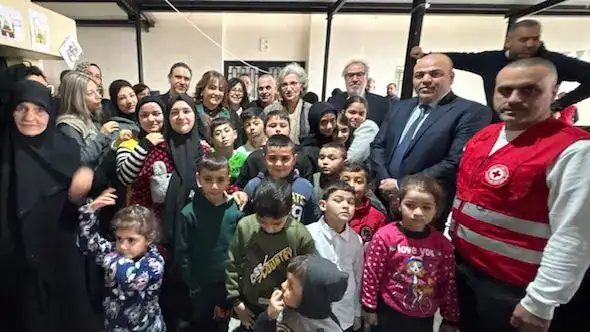
Minister of Education and Higher Education Rima Karami visited Amchit Public School in the Jbeil District, which hosts 93 displaced persons from the towns of Nabatieh and the Beqaa. She was received by the Head of the Jbeil District Disaster Crisis Unit, Acting District Commissioner Nathalie Merhi Khoury, along with unit members; Municipal Council member of Amchit, Zafer Suleiman, representing the Mayor, Joseph Khoury; members of the Municipal Council; Mukhtars Bassim Khalifeh, Tony Lahoud, and Wadie Nofal; Head of the Educational District, Gilbert Sakhn; the school’s principal, Claudie Bassil; members of the teaching staff; a number of principals from public schools in the district; the Chairman of the IPT Company, Zakhia Issa; and other interested parties.
After touring the center and listening to the displaced families’ demands and concerns, Karami said: “Today’s visit is a symbolic one, aimed at expressing the government’s support for the displaced families and standing by them amid current circumstances. It carries a clear message that the state stands alongside its citizens, recognizes the magnitude of the challenges they face, and is doing its utmost to provide as many of their needs as possible within the available resources.”
She saluted mothers on their day, “who embody an inspiring example of resilience and sacrifice, especially in these difficult circumstances, as they continue to support their families and maintain their unity.”
She emphasized that “the government is exerting its utmost efforts to secure basic necessities,” noting that “the Ministry of Education has placed all schools at the disposal of the Relief Authority, while the teaching staff, in cooperation with the Ministry of Social Affairs, continues to play a pivotal role in meeting the needs of affected families, through an integrated task force that works to monitor the situation on the ground.”

She announced, in response to a question, that “the issue of official examinations will be discussed in the coming two weeks, once the launch and continuity of the educational process for all students is ensured.” She added: “The ministry has begun implementing the gradual education plan, while continuing to communicate with families in affected areas, particularly in unsafe regions in the south. A crisis cell has also been formed within the Ministry of Education, holding daily meetings to monitor developments and assess the varying circumstances of families, with the aim of making comprehensive decisions that address everyone’s needs. In addition, the ministry is working in cooperation with donor agencies to provide learning materials for households in unsafe areas, alongside efforts to improve the quality of online education and methods of lesson delivery.”
She added: “As for higher education, the Lebanese University, along with a number of other universities, has adopted a distance learning system for the current stage, while emphasizing that the return to in-person education will take place as soon as the appropriate conditions are available in any given area. A gradual approach will be adopted for reopening schools using available buildings, with an immediate switch to distance learning if the need arises to use these buildings as shelter centers.”
She affirmed that “the President’s initiative to end the war remains on the table,” expressing hope for “reaching a solution through diplomatic means amid the complex regional situation.”
In response to a question about the recent statement by U.S. Ambassador Michel Issa that there is no solution except through negotiations with Israel, she said: “All wars end with reaching an agreement, and that’s what happened last year, and that’s what will happen today. But the question remains: under what conditions? This is left to the competent diplomatic and security authorities to determine.”